
Ancient Egypt
 Ancient Egypt is traditionally divided into three main kingdoms: the Old Kingdom, the Middle Kingdom, and the New Kingdom. Each kingdom represents a distinct period of Egyptian history, marked by political stability, prosperity, and cultural development. These periods were often followed by intermediate periods of instability, marked by invasions or internal strife. Here’s a closer look at each:
1. Old Kingdom (c. 2686–2181 BCE)
- Known as: The “Age of the Pyramids.”
- The Old Kingdom is perhaps best known for the construction of the pyramids, particularly the Great Pyramid of Giza, built during the Fourth Dynasty under Pharaoh Khufu (Cheops).
- This period saw the solidification of the pharaoh’s divine authority as the absolute ruler, and the centralized state was strong. The role of the pharaoh as a living god was crucial to maintaining order and stability.
- The Old Kingdom also saw the development of a highly structured society, with powerful nobles and skilled laborers.
- However, by the end of the Old Kingdom, political instability and economic troubles led to the collapse of centralized power, leading into the First Intermediate Period (c. 2181–2055 BCE).
2. Middle Kingdom (c. 2055–1650 BCE)
- Known as: The “Period of Reunification.”
- The Middle Kingdom followed the political chaos of the First Intermediate Period. It began with the reunification of Egypt under Mentuhotep II of the 11th Dynasty, who restored order and stability to the kingdom.
- The Middle Kingdom was marked by a resurgence in building projects, including impressive fortifications and temples. The pharaohs during this period were often seen as more benevolent rulers, working to improve the lives of their people through large-scale irrigation projects and military campaigns.
- The 12th Dynasty, which is often considered the high point of the Middle Kingdom, saw great prosperity, with Egypt’s borders expanding, particularly in the south, into Nubia.
- The Middle Kingdom ended when Egypt faced invasions and internal struggles, leading into the Second Intermediate Period (c. 1650–1550 BCE).
3. New Kingdom (c. 1550–1077 BCE)
- Known as: The “Empire Period.”
- The New Kingdom is considered Egypt’s most prosperous and powerful era, when Egypt became an empire and its influence spread far beyond its borders.
- This period began with the expulsion of the Hyksos (a Semitic people who had ruled parts of Egypt during the Second Intermediate Period) and the reunification of Egypt under Ahmose I, marking the start of the 18th Dynasty.
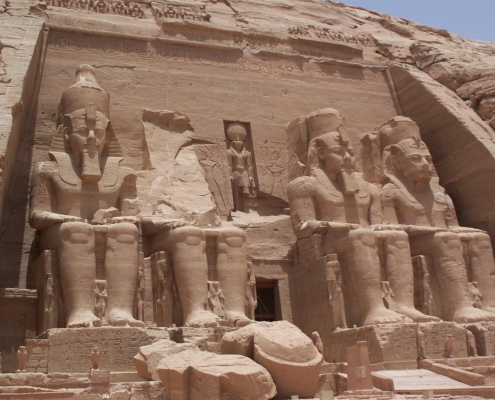
- The New Kingdom is famous for its military conquests, particularly under pharaohs like Thutmose III, who expanded Egypt’s territory into Nubia, Syria, and Palestine, and Ramesses II (often called Ramses the Great), whose reign saw the famous Battle of Kadesh.
- The era is also known for its grand building projects, including the magnificent temples at Karnak and Luxor, the tombs in the Valley of the Kings (including Tutankhamun‘s tomb), and the mortuary temples of powerful pharaohs.
- The New Kingdom also saw the reign of Hatshepsut, one of the few female pharaohs, who was known for her extensive building programs and trading expeditions, and Akhenaten, who introduced monotheism with the worship of the sun god Aten (though this idea largely died out after his death).
- The New Kingdom eventually declined, giving way to the Third Intermediate Period (c. 1077–664 BCE), which saw Egypt fragment into smaller, weaker states and faced invasions from the Libyans and Assyrians.
 Key Highlights:
- Old Kingdom: Pyramids, centralized state, collapse due to internal strife.
- Middle Kingdom: Reunification, prosperity, military expansion, and cultural achievements.
- New Kingdom: Egypt’s empire period, military conquests, monumental building projects, and influential pharaohs.
These kingdoms are often seen as the high points of ancient Egyptian civilization, with each contributing to Egypt’s legacy as one of the world’s oldest and most influential cultures.